
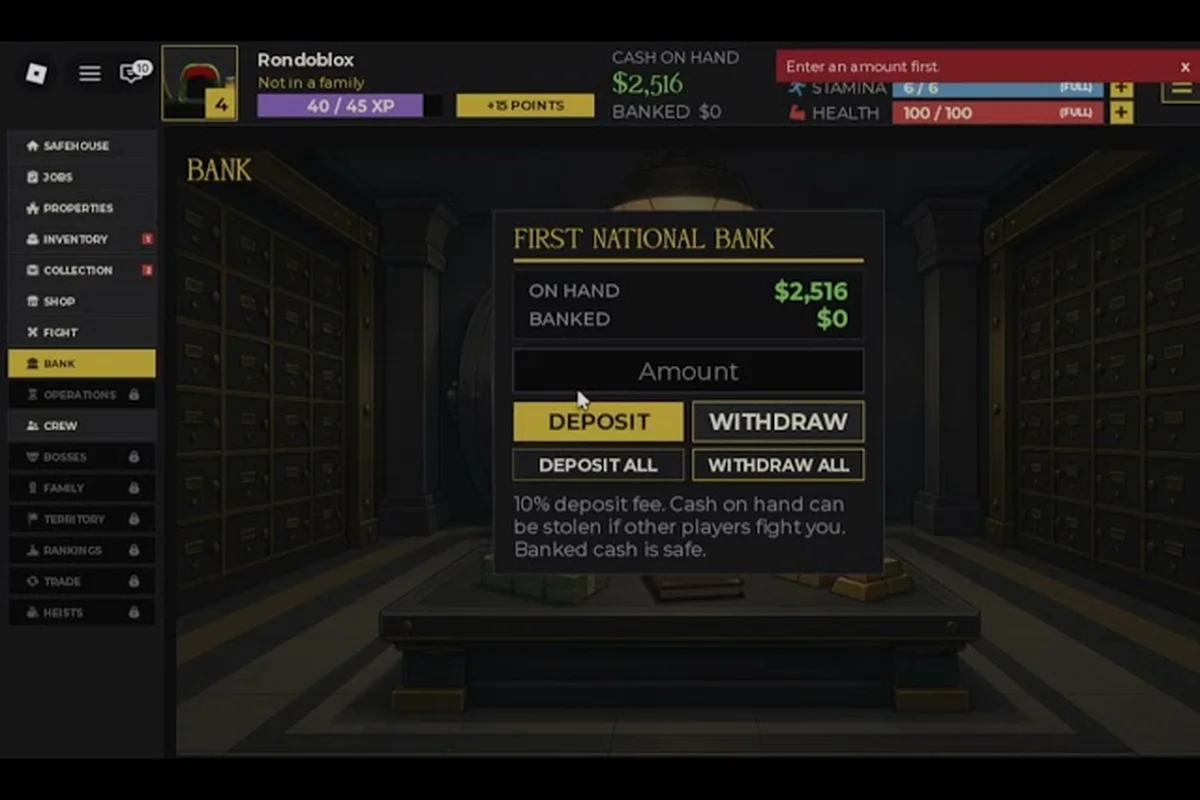
Most idle games reward logging off, but Idle Mafia Game actually hands you a reason to stay at the screen. The choice between grinding jobs, swapping capos, and chasing PvP wins versus letting your warehouses and clubs print cash while you sleep is the single decision that shapes your first week on the official Idle Mafia Game Roblox page. This idle mafia game active play vs idle guide breaks down exactly when your minutes at the keyboard earn more than the 25% offline income rate, and when that 25% is honestly the better deal.
Active Play vs Idle Income at a Glance
Active play and idle income run on two completely different clocks, and confusing them is the fastest way to stall your account. Active play converts your time and Energy into cash, levels, and Skill Points right now. Idle income converts property ownership, capos, and group bonuses into a slow stream of cash that runs whether you are clicking or not.
The official game page reports an average session length of about 25 minutes, which roughly matches the time it takes a focused player to clear a queue of jobs, place a fresh capo, and log a property upgrade before stepping away. The key comparison sits in the table below.
| Dimension | Active Play | Idle Income |
|---|---|---|
| Primary resource spent | Energy (job runs) and attention | Properties + Capos (passive) |
| Cash multiplier | 100% of job payout + job-level bonuses | 25% of active rate while offline |
| Best window | First 25-40 minutes of a session | 2-12 hour breaks between sessions |
| Caps progression? | Yes — levels, Skill Points, Energy cap | Slow — income only, no XP or levels |
| Risk if ignored | None (you can leave anytime) | High — log back in with no upgrade path |
| Best fit | Job levels, boss attempts, PvP pushes | Sleep, school, work, queue breaks |
The 25% offline rate is the single most important number in this whole article. It means a property that prints $10,000 per hour while you click will print $2,500 per hour while you are away. If your active hourly rate is more than four times your idle hourly rate, playing actively is the right call. If it is less, walking away is mathematically correct.
The Energy Economy Behind Every Active Session
Every active decision in the game is gated by Energy, the bar that fuels job runs, capo promotions, and most PvP duels. According to community testing, every job consumes a slice of Energy, the bar refills at a slow steady tick, and raising your cap requires both leveling up and spending Skill Points into the Energy node. The RobloBliss energy walkthrough shows that pacing jobs around your cap earns more cash than spamming whatever job is cheapest.
How Energy Drains and Refills
Energy behaves like a bucket with a small leak. Each job you take dumps some water out, and the leak slowly refills it in the background. Two design rules follow from that model, and both matter for the active play decision.
-
A capped bar means every job you run is pure profit; a half-empty bar means the same job is costing you the refilled time of the next run.
-
Pacing matters more than clicking speed. Three jobs at full cap often beat five jobs spammed back to back because the refill drip is never wasted on empty stamina.
Translating Energy Into Cash Per Minute
The table below compares a few sample job tiers reported by early players, with payouts ranging from roughly $50 at Tier 1 entry jobs up to $10,000+ at Tier 4 boss jobs. Exact dollar amounts shift with each patch and depend heavily on your Skill Point layout, so treat the cash-per-energy ratios as the real signal — Tier 1 hovers around 50-150, while Tier 4 boss jobs clear 500 per point of Energy spent. Use this ratio as your north star when deciding whether to keep grinding actively or bank the gains and let idle income tick over.
| Job Tier | Approx. Payout | Energy Cost | Cash per Energy | Best Use |
|---|---|---|---|---|
| Tier 1 entry jobs | $50-150 | 1 | 50-150 | First 10 minutes, no energy upgrade yet |
| Tier 2 mid jobs | $400-900 | 3-4 | 100-225 | Core of an active grind |
| Tier 3 high jobs | $2,000-5,000 | 8-12 | 200-400 | Once cap and Skill Points are raised |
| Tier 4 boss jobs | $10,000+ | 20+ | 500+ | End of session, after cap is maxed |
Notice how the cash per energy climbs steeply with tier. That is the engine of active play: the longer you stay online, the more your Skill Points and Energy cap lift, and the more each individual job is worth. The reverse is also true — leaving the game at Tier 1 jobs means your next 12 hours of idle income are anchored to a tiny cash per energy ratio.
Idle Income: Properties, Capos, and the 25% Offline Rate
Idle income is the sum of three layers stacked on top of each other, and understanding each layer is what lets you tune the ratio between active and idle hours. Properties generate a slow, continuous baseline that keeps ticking even when your phone is off, Capos multiply that baseline through combat and assignment bonuses, and the 25% offline rate acts as a global multiplier that sharply penalizes raw AFK time — so a player who only logs in for 5-minute collection bursts actually harvests a much higher effective-per-hour rate than one who stays away for 8 hours straight.
How Offline Earnings Are Reduced
The game pays you 25% of your active property income when you are offline. This number is not a flat penalty — it is a design choice that forces a tradeoff. A player with $100,000 of active hourly income walks away with $25,000 per hour while AFK. A player with $400,000 of active hourly income walks away with $100,000 per hour while AFK. The 25% rate does not punish you for logging off, but it does mean your idle plan only works if your active plan has already built up a strong baseline.
Properties as the Idle Engine
Properties are the workhorses of passive income, and the property investment angle is the cleanest way to think about them. A cheap early property prints small dollars constantly; a late-game warehouse prints large dollars constantly. The wrong move is stacking too many cheap properties because the upgrade curve gets expensive and the per-property yield plateaus. The right move is a small portfolio of higher-tier properties that hit a strong cash-per-hour floor before you even think about a long break.
Capos as Multipliers
Capos sit on your properties and multiply the cash they print, which is why a capos beginner guide is so closely tied to idle income. A leveled, awakened capo on a fully upgraded property is a completely different income curve than an empty property. The first capo you place is the single biggest jump in idle income most players will ever see, because it converts a static property into a multiplied one.
Income Multipliers: Group and Like
Joining the Stacks of Cash developer group adds roughly 10% to passive property income, and liking the game adds another small percentage. These bonuses are free, they stack with the capo multiplier, and they apply even while you are offline. Skipping them is leaving easy idle dollars on the table.
When to Go Active and When to Go Idle
The decision tree below breaks Idle Mafia Game's three core session patterns — push, tune, and bed — against the practical milestones of capos placement, property upgrades, and group bonus unlock. Each row tells you not just which pattern fits, but when it actually starts paying off: a push session only beats idle when your Energy cap is still under roughly 5,000 XP/hr, while a bed session only outperforms a tune once your capos are placed and the 25% offline rate multiplies a meaningful base income.
| Session Type | Active Time | Idle Window | Best For | Cash Result |
|---|---|---|---|---|
| Push session | 30-45 min | None | Early-game level grind, first Skill Points | Highest XP, fastest cap raise |
| Tune session | 15-20 min | 2-6 hours | Mid-game property upgrades, capo swaps | Balanced cash + idle seeding |
| Bed session | 5 min | 8-12 hours | Late-game cap check, log-off optimization | Maximum offline cash |
| School/work session | 2-3 min | 6-10 hours | Daily check-in, code redemption | Steady drip, no burnout |
The push session is the right call for your first three to five days because you need levels, Skill Points, and Energy cap to make idle income meaningful. The tune session becomes the default once you have two or three solid properties online. The bed session only works after your capos are placed, your properties are upgraded, and your group bonus is unlocked — otherwise the 25% offline rate is just a slow leak of small dollars.
Reading the 25% Math in Practice
A simple example clarifies the math. Suppose your active cash per hour sits at $80,000 after the first week, which is a normal mid-game figure according to community testing. Your offline rate would be around $20,000 per hour. That is $160,000 across an 8-hour sleep, which is solid idle income without lifting a finger. If you instead spent those 8 hours actively grinding, you might earn $400,000-500,000 — but you also lost 8 hours of your day. The active path only wins if you value your time below the gap, or if you need levels rather than cash.
A Sample 24-Hour Schedule
Splitting the day into a 25-minute push, a 15-minute tune, and two long idle blocks is the core idea behind the table below, and the timing is chosen specifically so that the 25% offline cap rate and group-bonus accumulation both tick over while you are away from the phone. The push windows are placed at commute edges so energy, daily code redemption, and boss attempts do not collide with work hours, while the short tune block is the only part of the day that actually requires conscious decisions like upgrading property, swapping capos, or reacting to a better pull. Treat this schedule as a template you can shift 12 hours if your boss timers and PvP reset are easier to hit in the evening.
| Time Block | Mode | Goal |
|---|---|---|
| 7:00-7:25 AM | Push | Clear energy, place first capo, redeem daily code |
| 7:25 AM-3:00 PM | Idle | Work or school, offline 25% rate runs |
| 3:00-3:15 PM | Tune | Upgrade property, swap capo if a better one was pulled |
| 3:15-11:00 PM | Idle | Second offline stretch, group bonus accumulates |
| 11:00-11:25 PM | Push | Boss attempt, PvP push, log off at cap |
That schedule gives you about 50 minutes of active time and roughly 22 hours of idle income, which is roughly the ratio the community has settled on for sustainable mid-game play. A new player can swap the morning push for an evening push and still see similar numbers, as long as the tune block is not skipped.
Beginner Mistakes That Wreck the Active vs Idle Balance
Most new players do not lose the active vs idle game because they picked the wrong mode. They lose it because they leak resources between modes without realizing it. The mistakes below show up constantly in community testing and on the official Discord.
-
Running Tier 1 jobs after the cap is raised. The cash per energy is so low that you would earn more by closing the game and letting properties print idle cash.
-
Buying a fifth cheap property before the first four are upgraded. Spread upgrades across fewer properties first so the idle floor is higher.
-
Skipping the group bonus. Leaving 10% of passive income on the table because you did not click "Join Group" is a free 10% loss forever.
-
Logging off at half energy. Every unspent energy point is a job you could have run that would have lifted your level and your cap for tomorrow's idle income.
-
Redeeming codes late. The active code "capo" is worth $10,000 right now and zero extra value next week.
The PVE vs PVP Active Choice
Active play also splits into PVE and PVP paths, and your mix matters for the idle math. PVE boss runs burn energy for guaranteed cash and skill unlocks, which is the right call when your energy cap is small and you need a safe return on every click. PVP duels burn energy for rank and rare capos, which is the right call once you have spare energy after PVE and want to push the rare drop curve. The PVE beginner angle is a good reset point if you have been PVP-only and feel stuck at low energy.
The Capos-vs-Properties Active Choice
Inside active play, you also choose between spending energy on capo pulls and spending it on property cash. Early game, property cash wins because the idle engine is empty. Mid game, capo pulls start winning because the idle engine is strong enough that each new multiplier moves the needle more than a few property dollars. A clean capos beginner plan usually looks like three days of pure property cash, then a pivot to half property, half capo pulls for the rest of the week.
Frequently Asked Questions
How long should my first active session be in Idle Mafia Game?
Plan for about 25 minutes on day one, which matches the average session length the official page reports. That window is enough to clear the early energy cap, place your first capo, and unlock a cheap property without burning out. Extend to 40 minutes only after your cap is raised and your Skill Points are spent into Energy.
Is the 25% offline income rate worth the time away from the screen?
Yes, once your idle engine is built. A mid-game account with two upgraded properties, a placed capo, and the group bonus earns a steady drip while AFK that adds up to meaningful dollars overnight. The rate is not worth it on day one because your idle engine is empty — spend that first day on a push session instead.
Should I spend energy on PVE or PVP as a beginner?
PVE first, every time. PVE jobs and boss runs give guaranteed cash and skill unlocks, which feed the idle engine. PVP is a rank-and-loot chase that only makes sense once you have spare energy after PVE is fully cleared. Mixing too early is the most common cause of slow first-week progress.
How many properties should I own before going mostly idle?
Three upgraded properties with at least one placed capo is a clean mid-game target. Below that, your idle income is too thin to justify long breaks. Above that, you spread upgrades too thin and each property stays underwhelming. The properties beginner angle is a good reference if you are unsure which three to pick first.
Does the active "capo" code expire soon?
According to community reports on the official Discord, "capo" was the only code confirmed active as of September 2026, and older codes like RELEASE, MAFIA, and UPDATE are widely reported as expired or one-time use. Redeem it during a push session rather than a tune session so the $10,000 lands while your active job queue is still running.